30-day yoga challenge for beginners
Thirty days of short daily practice — 10 to 30 minutes — with a theme each week: foundations, hips, strength and balance, then flow. Every pose is explained with an easier version, props are encouraged, and you don’t need to be flexible to start.
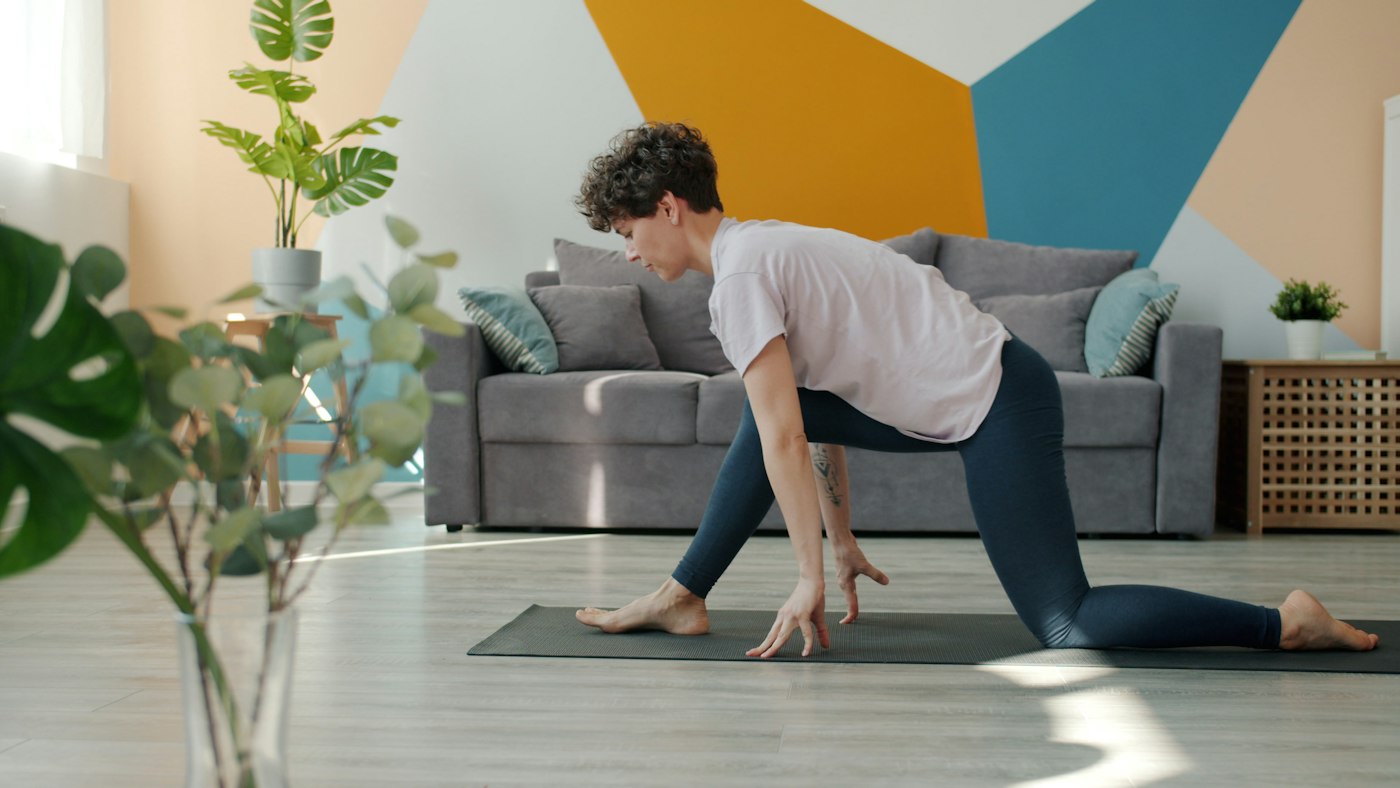
You do not need to be flexible to start. That’s what stops most people, and it has the logic backwards — flexibility is what practice produces, not what it requires. Every pose below has a version for stiff hips and tight hamstrings, and props aren’t cheating; they’re what they’re for.
This is a written plan rather than a video series: 30 days of short practices, a theme each week, and a gentle or rest day in every one.
Before you start
General information only, not medical advice. Check with a doctor before starting, especially if you’re pregnant or postpartum, injured, have a joint, back or eye condition, have high blood pressure or another medical condition, or take medication. A qualified teacher can help with form. Move gently and stop if you feel sharp pain — see who should modify or skip this below.
Challenge at a glance
| Duration | 30 days |
|---|---|
| Daily time | 10–30 minutes, building across the month |
| Equipment | A mat. Blocks, a strap and a cushion are optional |
| Difficulty | Complete beginners welcome |
| Weekly themes | Foundations · hips · strength and balance · flow |
| Rest | A gentle day and a rest day every week |
| Goal | A practice you keep doing |
How the challenge works
- Follow the day’s session in order — each warms up, works, then winds down. The last pose is the point, not an afterthought.
- Stay within a comfortable range — a stretch you could hold while breathing normally. Sharp, pinching or electrical sensations mean come out.
- Use props freely. A block under a hand, a cushion under your hips, a strap round a foot — these make poses work better, not less.
- Breathe through your nose, slowly, and never hold your breath. If your breath gets ragged, the pose is too much for today.
- Don’t compete, including with yourself. Depth isn’t the measure; showing up is.
What you need
A mat, clothes you can move in, bare feet, and floor enough to lie down with your arms out. A quiet half hour helps more than equipment.
Household substitutes work fine: thick books for blocks, a belt or towel for a strap, a firm cushion or folded blanket under hips or knees, and a wall — the most useful prop there is for balances.
A short note on where this comes from: yoga originated in ancient India as a broad philosophical and spiritual discipline, and what most Western classes teach — including this plan — is primarily asana, the physical postures, which is one part of a much larger tradition.
The 30-day yoga plan
Hold times are a guide. “5 breaths” is roughly 30 seconds taken slowly.
| Day | Session |
|---|---|
| Week 1 — foundations (10–15 minutes) | |
| 1 | 2 min seated breathing · 8 cat-cows · child’s pose 1 min · forward fold 5 breaths · downward dog 5 breaths |
| 2 | Mountain · forward fold · downward dog · low lunge 5 breaths each side · warrior II 5 each · child’s pose |
| 3 | 2 min breathing · 10 cat-cows · cobra 3 × 5 breaths · downward dog · reclined twist 1 min each side |
| 4 | First flow: mountain → forward fold → halfway lift → plank → knees down → cobra → downward dog. 4 slow rounds · warrior II · 3 min rest pose |
| 5 | Tree 5 breaths each side (use a wall) · chair 5 breaths × 3 · warrior II · forward fold · rest pose |
| 6 | Gentle: cat-cows · child’s pose · butterfly 2 min · reclined twist · legs up the wall 3 min · rest pose 5 min |
| 7 | Rest, or 10 minutes of whatever felt best this week |
| Week 2 — hips and flexibility (15–20 minutes) | |
| 8 | Low lunge 1 min each · butterfly 2 min · figure-four 1 min each · happy baby · rest pose |
| 9 | 3 rounds of the flow · low lunge with a twist 5 breaths each · seated forward fold 1 min |
| 10 | Downward dog · forward fold 1 min · half split 1 min each · seated forward fold 2 min · reclined hamstring stretch 1 min each |
| 11 | Figure-four or pigeon 2 min each · butterfly 2 min · wide child’s pose 2 min · reclined twist |
| 12 | 4 rounds of the flow · warrior II → extended side angle 5 breaths each · triangle 5 each · rest pose |
| 13 | Gentle: cat-cows · child’s pose · butterfly · legs up the wall 5 min · 5 min breathing |
| 14 | Rest |
| Week 3 — strength and balance (20–25 minutes) | |
| 15 | Plank 20 sec × 3 · chair 5 breaths × 3 · warrior I 5 each · locust 5 breaths × 3 · child’s pose |
| 16 | Tree 8 breaths each · warrior III with a hand on the wall 5 each · chair · eagle arms · rest pose |
| 17 | 5 rounds of the flow · side plank on a knee 20 sec each · bridge 5 breaths × 3 · reclined twist |
| 18 | Plank 30 sec × 3 · chair × 3 · 8 slow downward dog to plank · locust × 3 · child’s pose |
| 19 | Tree · warrior III · half moon at the wall 5 each · chair with a twist 5 each · rest pose |
| 20 | Longer practice: 5 rounds of flow · warrior I, II and triangle · tree · bridge · rest pose 5 min |
| 21 | Rest |
| Week 4 — flow and relaxation (25–30 minutes) | |
| 22 | 6 rounds of the flow, moving with the breath · warrior sequence · rest pose 5 min |
| 23 | 4 rounds of flow · figure-four or pigeon 2 min each · half split · seated forward fold 2 min |
| 24 | Plank 40 sec × 3 · chair × 3 · bridge × 3 · locust × 3 · reclined twist |
| 25 | Long holds: 2 min each — low lunge, butterfly, forward fold, child’s pose, reclined twist, legs up the wall |
| 26 | 5 rounds of flow · tree · warrior III · triangle · rest pose 5 min |
| 27 | Full practice — flow, standing poses, a balance, a backbend, hips, long rest pose |
| 28 | Rest |
| Finish | |
| 29 | Gentle 15 minutes, finishing with 5 minutes of breathing |
| 30 | The full 30-minute practice. Then sit for a minute and notice what’s different from day 1. |
The poses explained
- Mountain — standing tall, feet together or hip-width, weight even. More active than it looks.
- Cat-cow — on all fours, arching and rounding the spine with the breath. Mistake: rushing. One breath per movement.
- Child’s pose — hips back to heels, forehead down. Easier: a cushion between heels and hips.
- Forward fold — hinge from the hips, head hanging. Mistake: locking the knees to get lower. Bend them as much as you need.
- Downward dog — hands and feet down, hips up and back, spine long. Mistake: forcing the heels down. Easier: bend both knees generously, or hands on a chair seat.
- Plank — one straight line from head to heels. Easier: knees down.
- Cobra and locust — face down, lifting the chest (hands by the ribs) or chest and legs (arms alongside). Mistake: cranking the neck back.
- Low lunge — one foot forward, back knee down, hips sinking. Easier: cushion under the back knee, hands on blocks.
- Warrior II — feet wide, front knee bent over the ankle, arms out. Mistake: leaning forward; stay stacked over your hips.
- Triangle and side angle — from a wide stance, reaching over the front leg. Easier: hand on a block or your shin, not the floor.
- Tree and warrior III — balances. Easier: hand on a wall, lifted foot at your ankle rather than your thigh. Everyone wobbles; that’s the exercise.
- Chair — sitting back as if into a chair, arms up. Mistake: knees drifting past the toes.
- Bridge — on your back, feet flat, lifting the hips. Mistake: arching the lower back rather than squeezing the glutes.
- Butterfly, figure-four, half split, happy baby — seated and reclined hip and hamstring stretches. Easier: sit on a folded blanket. Keep them all gentle.
- Reclined twist, legs up the wall, rest pose — the wind-down. Rest pose means lying still, and it’s a pose, not a break.
Breathing and mindset
Breathe in and out through your nose, slowly, and let the breath lead the movement rather than catch up with it — in the flow, you move on an exhale and settle on an inhale. The practical use is diagnostic: when you can’t breathe smoothly, you’ve gone too far, which is a better guide than how a pose is supposed to look.
The mindset half is harder than the poses. Yoga makes it easy to compare yourself to a photograph, and every pose has a version that looks less impressive and does more for you. Bent knees in a forward fold, a block under a hand in triangle, a wall for balance — not the beginner’s version, but how the pose is meant to feel.
Many people also find the slow pace and the breathing calming; that’s a commonly reported experience rather than a medical claim. For stress or low mood specifically, this is worth doing alongside proper support, not instead of it.
Beginner and advanced modifications
If you need it easier
- Bend your knees in every forward fold and in downward dog.
- Use the wall for every balance, and blocks or books under your hands.
- Shorter holds — three breaths instead of five, and skip the extra rounds of flow.
- Chair options — forward folds, twists and warrior poses all work seated, worth knowing if getting up and down from the floor is the obstacle.
If you need it harder
- Longer holds — eight to ten breaths, which changes the character of a pose entirely.
- More rounds of flow, with full plank and no knees down.
- Deeper variations — pigeon rather than figure-four, warrior III without the wall, full side plank.
- Link the day’s poses into one continuous sequence rather than taking them separately.
Who should modify or skip this challenge
Speak to a doctor or a qualified teacher before day 1 if any of these apply:
- Glaucoma or another eye condition, or uncontrolled high blood pressure. Poses where your head goes below your heart — downward dog, forward folds, legs up the wall — raise pressure in the head and are commonly cautioned against here. Easy to substitute, but get it cleared first
- Wrist problems or carpal tunnel syndrome — downward dog and plank both load the wrists. Fists, a folded towel under the heels of the hands, or forearm versions usually help
- Back, neck, knee, hip or shoulder problems, current or recurring
- Pregnancy — deep twists, lying face down and lying flat on your back later on all usually need changing. Look for a teacher with prenatal training
- Postpartum, especially with abdominal separation or after a caesarean
- Recent surgery or injury, or any condition affecting your balance
Mild stretch and next-day muscle soreness are normal. Joint pain, nerve-like tingling, pinching in a joint or dizziness are not — come out of the pose and get advice.
What to do if you miss a day
Carry on with the next day. Don’t double up and don’t restart — yoga rewards frequency over length, and a 10-minute practice counts as a day. Miss a week and repeat that week rather than jumping forward.
What to expect from 30 days
Three things, usually. Flexibility improves, first in the hips and hamstrings and faster than people expect. Balance improves markedly — tree pose at day 25 is a different experience from day 5. And the poses stop requiring thought, which is when a practice starts being enjoyable rather than an instruction list.
You’ll also have a routine, which is the part worth keeping. Ten minutes most days beats an hour once a fortnight.
What a month of yoga won’t do is change your weight or reshape you, and this page won’t claim it treats any condition. What it reliably offers is mobility, balance, body awareness and a quiet half hour — plenty, and it doesn’t need embellishing.
Printable calendar
All 30 days by week, with the poses on each row.
Common questions
What if I’m not flexible?
Then you’re who this plan is for. Nothing here needs you to touch your toes — bend your knees, sit on a cushion, use a wall and a couple of books. Hips and hamstrings are where beginners notice change first, often within a few weeks.
Is yoga good for beginners?
Yes, with one caveat: it’s easy to overdo on enthusiasm, because stretching feels productive right up to the point where it isn’t. Stay in a range you can breathe normally in and let depth arrive on its own.
How long should a yoga session be?
Ten minutes done most days is more useful than ninety minutes done occasionally. This plan starts at 10 to 15 minutes and finishes around 30, which is a realistic daily practice to keep going afterwards.
How often should beginners practise?
Five or six days a week is fine at this intensity, which is what the plan does. Yoga is low-impact enough for daily practice, but a day off helps the enthusiasm as much as the body.
Do I need to follow a video?
No — this plan is written so you don’t have to, which helps if you’d rather not have a screen on. That said, one in-person class with a qualified teacher will tell you more about your alignment than a month of videos.
What to try next
The closest relative is the 30-day Pilates challenge — mat-based and low-impact too, but repetition-based and core-centred rather than built on held postures. For strength and cardio alongside this, the 30-day workout challenge, or the plank challenge for a stronger core to hold these poses with.

Tayiba Shabir
Tayiba writes LifestyleRoot’s home, living and habit guides — practical plans you can actually follow, without the hype. She isn’t a yoga teacher, and recommends one class with a qualified one if you can manage it.
30-Day Yoga Challenge Calendar
The flow = mountain → forward fold → halfway lift → plank → knees down → cobra → downward dog. “5 breaths” is about 30 seconds taken slowly. Bend your knees, use a wall and books as props, and stay in a range you can breathe normally in. If you have an eye condition or high blood pressure, read the safety notes on the page before doing head-down poses.
Week 1 — foundations
- 1Breathing · 8 cat-cows · child’s pose · forward fold · dog
- 2Mountain · fold · dog · low lunge · warrior II · child’s pose
- 3Breathing · 10 cat-cows · cobra ×3 · dog · reclined twist
- 4First flow ×4 · warrior II · 3 min rest pose
- 5Tree (wall) · chair ×3 · warrior II · fold · rest pose
- 6Gentle — butterfly · twist · legs up wall · rest pose 5 min
- 7Rest, or 10 min of a favourite
Week 2 — hips
- 8Low lunge · butterfly · figure-four · happy baby
- 9Flow ×3 · low lunge twist · seated forward fold
- 10Dog · fold · half split · seated fold · reclined hamstring
- 11Figure-four or pigeon · butterfly · wide child’s · twist
- 12Flow ×4 · warrior II → side angle · triangle
- 13Gentle — legs up wall 5 min · breathing 5 min
- 14Rest
Week 3 — strength & balance
- 15Plank 20s ×3 · chair ×3 · warrior I · locust ×3
- 16Tree · warrior III (wall) · chair · eagle arms
- 17Flow ×5 · knee side plank 20s · bridge ×3 · twist
- 18Plank 30s ×3 · chair ×3 · 8 dog-to-plank · locust ×3
- 19Tree · warrior III · half moon at wall · chair twist
- 20Longer practice — flow ×5 · warriors · triangle · tree · bridge
- 21Rest
Week 4 & finish
- 22Flow ×6 with the breath · warriors · rest pose 5 min
- 23Flow ×4 · pigeon or figure-four · half split · seated fold
- 24Plank 40s ×3 · chair ×3 · bridge ×3 · locust ×3
- 25Long holds — 2 min each, six poses
- 26Flow ×5 · tree · warrior III · triangle · rest pose
- 27Full practice
- 28Rest
- 29Gentle 15 min + 5 min breathing
- 30The full 30-minute practice
Come out of any pose for joint pain, pinching, tingling or dizziness. Mild stretch and next-day soreness are fine. General information only, not medical advice. · lifestyleroot.com/habits-challenge/30-day-yoga-challenge/