30-day Pilates challenge (free beginner mat plan)
A full mat Pilates plan for beginners — 10 to 30 minutes a day, a stretch day and a rest day every week, and every exercise explained with an easier version. All of it is on this page. Nothing to sign up for, and all you need is a mat.
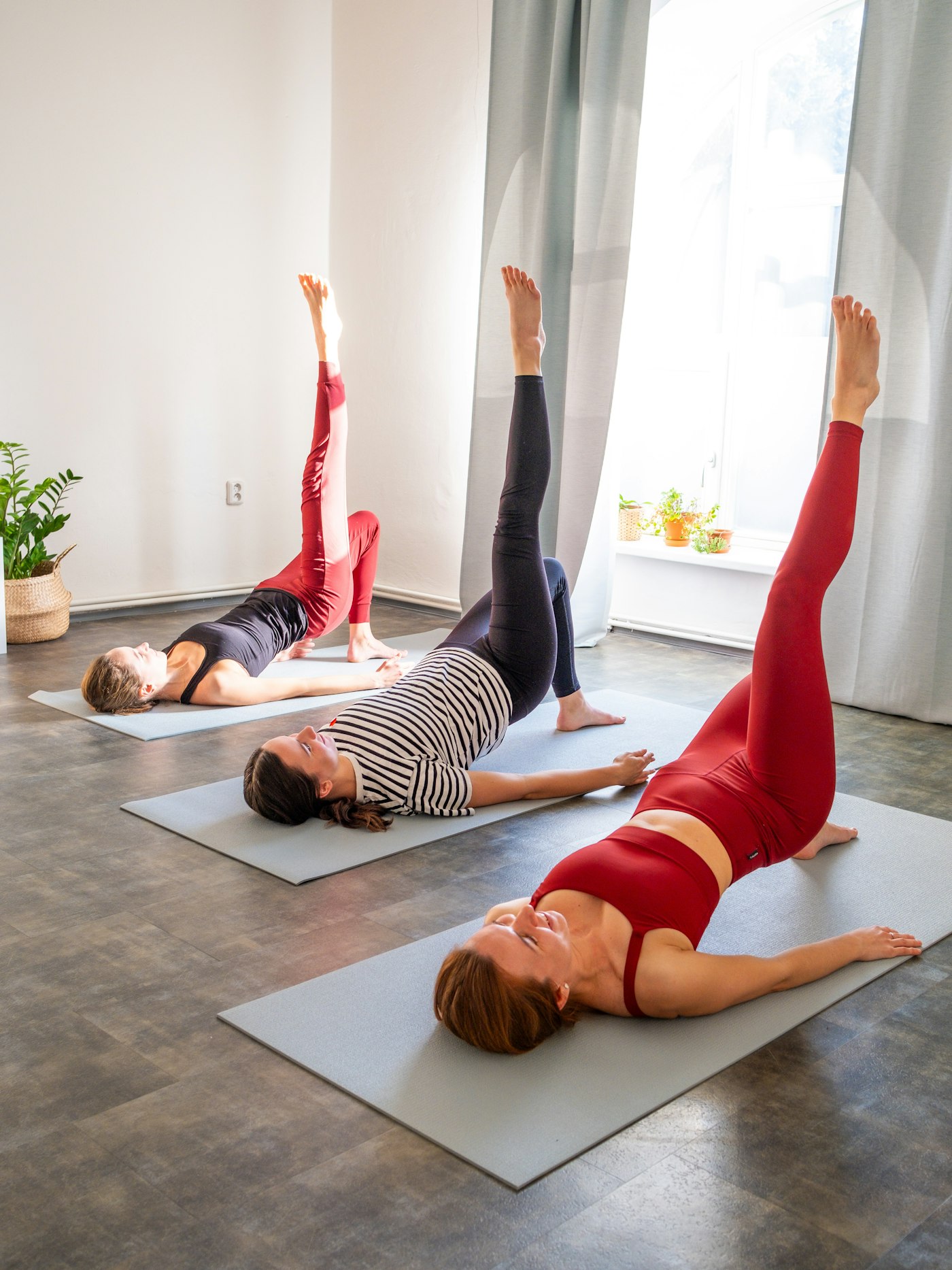
Most “free” Pilates challenges turn out to want an email address, or sell you the calendar. The entire plan is below — 30 days, named exercises, reps and holds, printable if you want it.
It’s for beginners. Week 1 is breathing and basic core engagement rather than anything strenuous, the exercises arrive gradually, and every week has a stretch day and a rest day.
Before you start
General information only, not medical advice. Check with a doctor before starting, especially if you’re pregnant or postpartum, injured, have a back, neck or bone density condition, have a medical condition, or take medication. A qualified instructor can help with form. Stop if you feel sharp pain — see who should modify or skip this below.
Challenge at a glance
| Duration | 30 days |
|---|---|
| Daily time | 10–30 minutes, building across the month |
| Equipment | A mat. Nothing else |
| Difficulty | Beginner, with easier options for every exercise |
| Weekly pattern | Four Pilates days · one stretch day · one more Pilates day · one rest day |
| Goal | Core control, mobility and a daily habit |
What is Pilates?
Mat Pilates is a system of slow, controlled exercises done on the floor, built around the muscles of your trunk — abdominals, lower back, hips and pelvic floor. The emphasis is precision rather than effort: fewer repetitions, done deliberately, coordinated with your breathing.
That’s the difference from most exercise. You’re not chasing reps or getting out of breath; you’re learning to move one part of your body while holding the rest still, which is harder than it sounds and carries over into everything else.
It’s distinct from yoga, though the two get muddled: Pilates is repetition-based and core-centred, developed as rehabilitation work, while yoga comes from a different tradition and leans on held postures, flexibility and balance. Plenty of people do both.
How the challenge works
- Do the day’s routine in order — the sequence is deliberate: warm the spine, then core, then side and back work.
- Slow down. If a set feels easy, you’re probably moving too fast. Control is the point; speed hides it.
- Modify freely. Every exercise has an easier version, and using it isn’t skipping — a smaller controlled range beats a big sloppy one.
- Breathe out on the effort, and never hold your breath. Pilates is coordinated with the breath rather than despite it.
- Stretch days and rest days are part of the plan, not a reward.
Before you start
A mat or folded blanket, clothes you can move in, bare feet, and space to lie down with your arms overhead. Two things Pilates relies on, worth a minute before day 1:
Breathing. In through your nose, letting your ribs widen sideways rather than your belly push out; out through your mouth, feeling your lower abdominals draw gently inward. That outward breath is where the core engagement comes from.
Neutral spine. On your back with knees bent, your lower back shouldn’t be flattened hard into the mat or arched away from it — there’s a small natural gap. Most exercises start from there, and finding it is most of what week 1 is for.
The 30-day Pilates plan
All 30 days, no sign-up. “10 each” means ten per side.
| Day | Routine |
|---|---|
| Week 1 — foundations (about 15 minutes) | |
| 1 | 10 breaths · 10 pelvic tilts · 8 knee folds each · 10 bridges |
| 2 | 10 breaths · 12 bridges · 10 toe taps each · 12 clams each |
| 3 | 10 pelvic tilts · the hundred, head down, 50 beats · 12 bridges · 8 single-leg stretch each |
| 4 | Stretch day — 8 cat-cows · 6 seated spine stretch · child’s pose · hamstring stretch |
| 5 | The hundred 50 · 10 single-leg stretch each · 15 bridges · 10 side-lying leg lifts each |
| 6 | 15 bridges · 15 clams each · 8 bird dogs each · 20-sec plank on knees |
| 7 | Rest |
| Week 2 — more exercises (about 20 minutes) | |
| 8 | The hundred 60 · 12 single-leg stretch each · 6 double-leg stretch · 15 bridges |
| 9 | Side-lying series: 12 lifts + 8 circles each side · 15 clams each · 15 bridges |
| 10 | The hundred 70 · 10 scissors each · 8 criss-cross each · 30-sec plank on knees |
| 11 | Stretch day — cat-cows · 8 spine stretch forward · 5 mermaid each side · hamstrings |
| 12 | The hundred 70 · 12 single-leg stretch · 8 double-leg stretch · swimming 20 beats · 18 bridges |
| 13 | 18 bridges · 8 single-leg bridges each · 10 bird dogs each · 30-sec plank |
| 14 | Rest |
| Week 3 — longer holds (about 25 minutes) | |
| 15 | The hundred 80 · 5 roll-ups · 14 single-leg stretch each · 10 double-leg stretch |
| 16 | Side-lying series: 15 lifts + 10 circles each · 18 clams each · 20-sec side plank on knees each |
| 17 | The hundred 80 · 12 scissors each · 10 criss-cross each · 40-sec plank |
| 18 | Stretch day |
| 19 | The hundred 90 · 6 roll-ups · swimming 30 beats · 8 spine stretch forward |
| 20 | 20 bridges · 10 single-leg bridges each · 12 bird dogs each · 40-sec plank · 25-sec side plank each |
| 21 | Rest |
| Week 4 — the full repertoire (about 30 minutes) | |
| 22 | The hundred 100 · 8 roll-ups · 16 single-leg stretch each · 12 double-leg stretch |
| 23 | Side-lying series: 18 lifts + 12 circles each · 20 clams each · 30-sec side plank each |
| 24 | The hundred 100 · 14 scissors each · 12 criss-cross each · 45-sec plank |
| 25 | Stretch day |
| 26 | The hundred 100 · 8 roll-ups · swimming 40 beats · 30-sec front support |
| 27 | Full flow — one set of every exercise in the plan, in order |
| 28 | Rest |
| Finish | |
| 29 | Light flow — half of day 27, then stretch |
| 30 | The full 30-minute routine. Every exercise, your best control. Notice what’s changed since day 1. |
The hundred runs from 50 beats to 100, which is the clearest thread to follow — but the real progress is in control, and you’ll notice it on day 30 doing exercises that were impossible to coordinate in week 1.
The main exercises explained
Each one with the usual mistake and an easier version.
- Pelvic tilt — knees bent, gently tip your pelvis so your lower back flattens, then release to neutral. Mistake: using your legs instead of your abdominals.
- Bridge — feet flat, press through the heels and lift your hips, rolling up one vertebra at a time. Mistake: arching your lower back at the top instead of squeezing your glutes. Easier: lift less high.
- The hundred — legs in tabletop or extended, head and shoulders lifted, arms long by your sides pumping small beats, breathing in for five and out for five. Mistake: straining the neck — the most common complaint in Pilates. Easier: keep your head down and bend your knees. A legitimate version, not a lesser one.
- Knee folds and toe taps — from tabletop, lower one foot toward the floor and back, pelvis completely still. Mistake: letting your back arch as the leg lowers.
- Single-leg stretch — one knee drawn in, other leg extended, switching smoothly. Mistake: pulling on the knee with your hands. Easier: head down, extended leg higher.
- Double-leg stretch — both knees in, then arms and legs extend away and circle back. Mistake: losing the lower back as the limbs extend. Easier: extend only the arms.
- Scissors and criss-cross — alternating straight legs, and the same with a rotation of the upper body. Mistake: pulling on the head, and rushing. Easier: bend the knees, head down for scissors.
- Roll-up — rolling slowly up to sitting and back down, one vertebra at a time. Mistake: momentum. Easier: bend your knees, or roll down only. With osteoporosis or low bone density this one is usually left out — see the safety section.
- Side-lying leg lifts, circles and clams — on your side, hips stacked, lifting or circling the top leg; clams open the top knee with heels together. Mistake: rolling the hips backward.
- Bird dog and swimming — on all fours, extend opposite arm and leg; swimming is the same face down with small flutters. Mistake: letting your hips rotate or your back sag.
- Plank and front support — one straight line from head to heels. Mistake: sagging hips. Easier: knees down.
- Spine stretch forward and mermaid — seated stretches for the stretch days, reaching forward over straight legs and sideways overhead.
Beginner and advanced modifications
If you need it easier
- Head down for anything that lifts the shoulders. Removes nearly all neck strain.
- Bend the knees wherever legs are straight, and keep them higher rather than lower.
- Smaller range, fewer reps, and a pause whenever you lose the position.
- A cushion under your head or a folded towel under your lower back.
If you need it harder
- Slow everything further — the strongest way to progress in Pilates.
- Straighten the legs and lower them, which lengthens the lever.
- Longer holds on planks and side planks, and an extra round of the flow.
- Light ankle weights or a resistance band for the side-lying series.
Who should modify or skip this challenge
Speak to a doctor, physiotherapist or a qualified Pilates instructor before day 1 if any of these apply:
- Osteoporosis or low bone density. Exercises that curl the spine forward under load — the roll-up especially, and the hundred and criss-cross with the head lifted — are commonly cautioned against, because loaded spinal flexion carries a fracture risk with reduced bone density. A professional can give you a version without them
- Back or neck problems, current or recurring
- Pregnancy — mat Pilates is often recommended, but several exercises here need changing and lying flat on your back is usually limited later on. Ask your midwife or doctor, and look for an instructor with antenatal training
- Postpartum, especially with abdominal separation (diastasis recti) or after a caesarean — a pelvic health physiotherapist is the right first step
- Recent surgery, a hernia, or any medical condition affecting your joints, bones or blood pressure
Mild muscle fatigue is expected. Neck pain, back pain or anything sharp is not — stop, and try the easier version rather than working through it.
What to do if you miss a day
Carry on with the next day. Don’t double up or restart — Pilates rewards regular short sessions far more than occasional long ones. Miss a week and repeat it rather than jumping forward.
What to expect from 30 days
Better core control, most noticeably. Thirty days is long enough to feel a real difference in how steadily you can hold a position while moving something else, and that shows up in ordinary ways: getting up off the floor, noticing when you’ve slumped at a desk.
Most beginners also gain mobility through the spine and hips, and find exercises that felt uncoordinated in week 1 become smooth. People with mild, non-specific back discomfort often report it easing, though that varies and isn’t something to count on.
What Pilates won’t do is reshape your body, and it isn’t a weight-loss programme. The familiar promises here — long lean muscles, a Pilates body, toning away a particular area — aren’t supported: you can’t lengthen a muscle with exercise, you can’t choose where fat comes off, and body composition is driven by nutrition and total activity over far longer than a month. What you get is control, mobility and posture awareness, which is enough.
Printable calendar
All 30 days on one page, with the exercises on each row.
Common questions
Is Pilates good for beginners?
One of the better starting points: every exercise scales down and nothing is high-impact. The catch is that it’s technical — the difference between a useful repetition and a wasted one is subtle, and harder to self-diagnose than with a squat. Going slowly, using the easier versions, and one class with a qualified instructor all help more than adding reps.
How often should I do Pilates?
Three to five a week suits most people, which is what this plan does — five Pilates days, one stretch day, one rest day. Daily short sessions are fine too, since it’s low-impact, but the rest days are there because control degrades when you’re tired, and tired Pilates is just movement.
Do I need a reformer?
No. A reformer is the spring-loaded studio machine — a different way of applying the same principles, and entirely optional. Everything here is mat Pilates, which is where most people start.
Is this challenge really free?
Yes — the whole plan is on this page and the printable version opens without an email address. We don’t gate it, which is the main reason this page exists.
What to try next
To go further on core strength, the abs challenge and the plank challenge both take minutes a day and sit well alongside this. For a broader month with strength and cardio, the 30-day workout challenge. A yoga challenge is next here.

Tayiba Shabir
Tayiba writes LifestyleRoot’s home, living and habit guides — practical plans you can actually follow, without the hype. She isn’t a Pilates instructor, and recommends one class with a qualified teacher if you can manage it.
30-Day Pilates Challenge Calendar
Do each routine in order, slowly. Breathe out on the effort, never hold your breath. “10 each” means ten per side. Head down is a legitimate version of anything that lifts the shoulders. If you have osteoporosis or low bone density, leave out the roll-up and keep your head down — and read the safety notes on the page first.
Week 1 — foundations
- 110 breaths · 10 pelvic tilts · 8 knee folds each · 10 bridges
- 210 breaths · 12 bridges · 10 toe taps each · 12 clams each
- 310 tilts · hundred 50 (head down) · 12 bridges · 8 single-leg stretch
- 4Stretch day — cat-cow, spine stretch, child’s pose, hamstrings
- 5Hundred 50 · 10 single-leg stretch · 15 bridges · 10 side leg lifts
- 615 bridges · 15 clams · 8 bird dogs each · 20s knee plank
- 7Rest
Week 2 — more exercises
- 8Hundred 60 · 12 single-leg · 6 double-leg · 15 bridges
- 9Side series 12 + 8 circles each · 15 clams · 15 bridges
- 10Hundred 70 · 10 scissors · 8 criss-cross · 30s knee plank
- 11Stretch day — + 5 mermaid each side
- 12Hundred 70 · 12 single-leg · 8 double-leg · swimming 20 · 18 bridges
- 1318 bridges · 8 single-leg bridges each · 10 bird dogs · 30s plank
- 14Rest
Week 3 — longer holds
- 15Hundred 80 · 5 roll-ups · 14 single-leg · 10 double-leg
- 16Side series 15 + 10 circles · 18 clams · 20s knee side plank
- 17Hundred 80 · 12 scissors · 10 criss-cross · 40s plank
- 18Stretch day
- 19Hundred 90 · 6 roll-ups · swimming 30 · 8 spine stretch
- 2020 bridges · 10 single-leg bridges · 12 bird dogs · 40s plank · 25s side
- 21Rest
Week 4 & finish
- 22Hundred 100 · 8 roll-ups · 16 single-leg · 12 double-leg
- 23Side series 18 + 12 circles · 20 clams · 30s side plank
- 24Hundred 100 · 14 scissors · 12 criss-cross · 45s plank
- 25Stretch day
- 26Hundred 100 · 8 roll-ups · swimming 40 · 30s front support
- 27Full flow — one set of everything, in order
- 28Rest
- 29Light flow — half of day 27 + stretch
- 30The full 30-minute routine
Stop for neck pain, back pain or anything sharp, and use the easier version rather than working through it. General information only, not medical advice. · lifestyleroot.com/habits-challenge/30-day-pilates-challenge/