30-day burpee challenge
A daily burpee total climbing from 5 to 70 over 30 days, with step-back and no-jump versions that are genuinely part of the plan rather than consolation prizes. No equipment, a few minutes a day, and more rest days than you’d expect.
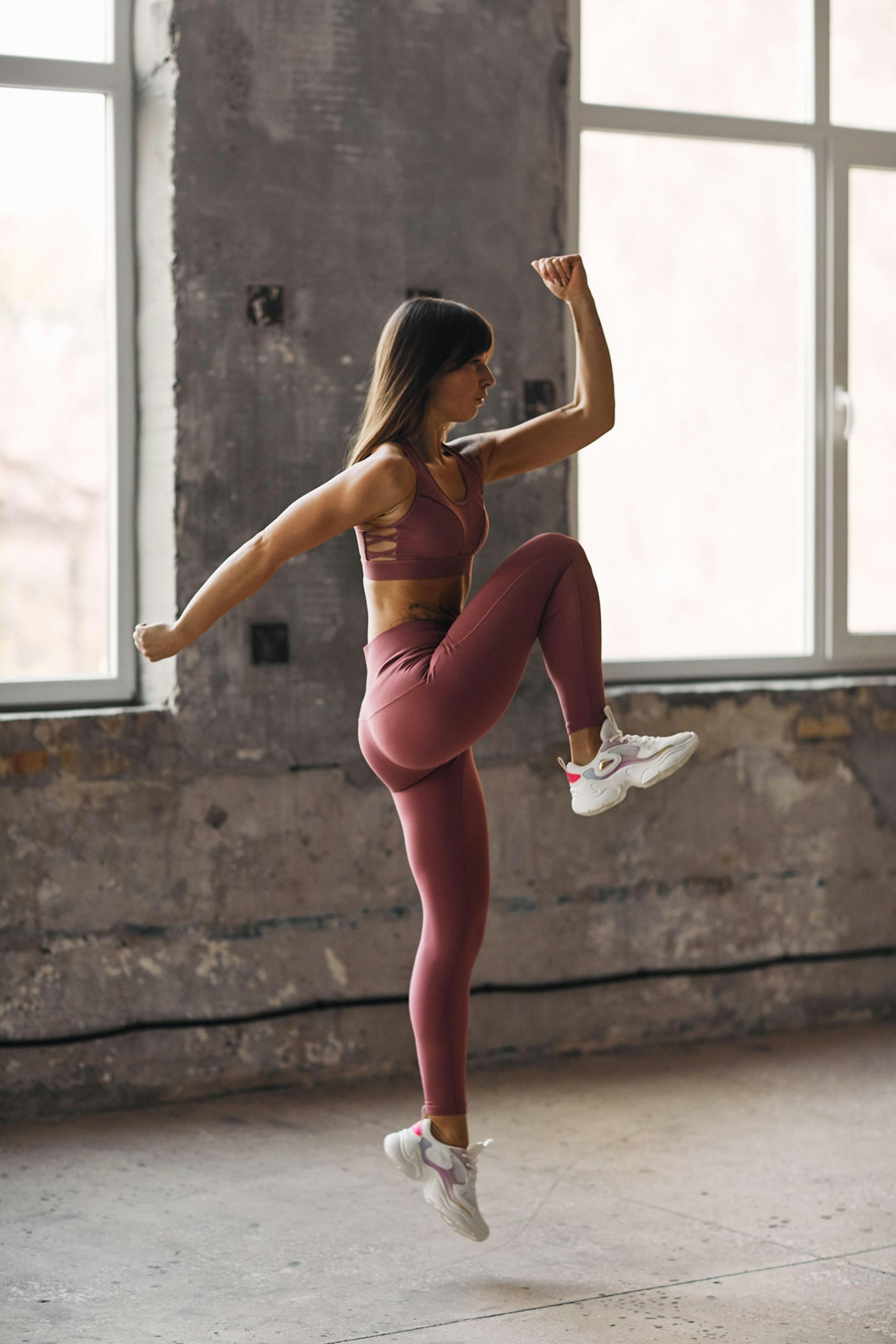
A burpee packs a squat, a plank, an optional push-up and an optional jump into one rep — which is why it’s the most effective bodyweight movement there is, and the one people quit fastest.
So this plan starts at five. It climbs to 70 by day 30, takes a rest day every fourth day, and treats the step-back and no-jump versions as real ways to do it. Charts that open at 20 reps look impressive and are why most people stop on day three.
Before you start
General information only, not medical advice. Burpees are high-intensity. Check with a doctor before starting, especially if you’re pregnant or postpartum, injured, have a heart, blood pressure or other medical condition, take medication, or haven’t exercised in a long time. Stop if you feel dizzy, short of breath or in sharp pain. See who should modify or skip this below.
Challenge at a glance
| Duration | 30 days |
|---|---|
| Daily time | 2–10 minutes |
| Equipment | None (a non-slip surface matters) |
| Starts at | 5 burpees |
| Finishes at | 70 burpees |
| Versions | Step-back, no-jump or full |
| Rest days | Every 4th day — seven in total |
| Goal | Conditioning, and a movement you can do well |
How the challenge works
- Hit the day’s total in as many sets as you need. Seven sets of five is the same as 35 and gives far better reps than one long grind.
- Rest days are not optional here. Burpees are the highest-intensity thing in this section, hence seven rest days rather than five.
- Stop a set when your form breaks, not when the number is reached. A sagging back and a heavy landing is the version that hurts people.
- Scale down rather than skip. Half the reps counts. A step-back version counts. A missed day doesn’t.
- Stop immediately if you feel dizzy or unusually short of breath. Not toughness territory — sit down, breathe, have water.
How to do a burpee properly
- Squat down and place both hands flat on the floor, shoulder-width apart, in front of your feet.
- Move your feet back into a plank — stepped one at a time, or jumped together for the full version. Straight line from head to heels.
- Optional push-up — chest to about a fist’s height off the floor, elbows back rather than flared.
- Bring your feet back in toward your hands, either stepping or hopping.
- Stand up, with an optional jump. Land softly, ball of the foot into the heel, knees bending to absorb it.
Four mistakes cause most burpee problems:
- Hips sagging in the plank — the fastest way to put a whole set’s load into your lower back. Squeeze your glutes as your feet land.
- Landing hard, flat-footed with straight legs. Bend to absorb it, or drop the jump.
- Rushing. A fast sloppy rep trains nothing except your tolerance for being out of breath.
- Collapsing the push-up into a half rep. If that’s what’s failing, use the no-push-up version rather than doing twenty bad ones.
Find your starting level
Pick by what you can currently do, not by what you’d like to be doing:
| If… | Your version |
|---|---|
| You’re new to this, or jumping and impact are a problem | Step-back — step the feet back and in, no push-up, stand up without a jump |
| You can hold a plank comfortably but the jump is too much | No-jump — jump the feet back, add the push-up if you can, stand without jumping |
| You can do 10 clean push-ups and jump without knee or ankle complaints | Full — jump back, push-up, jump up |
A step-back burpee is still a burpee. Same movement pattern with the impact taken out, and 70 of them on day 30 is a genuinely hard day’s work. These versions exist because the alternative — doing the full version badly — is both less useful and more likely to hurt. Re-test around day 15 and move up if you want to.
The 30-day burpee plan
| Day | Burpees | Day | Burpees | Day | Burpees |
|---|---|---|---|---|---|
| 1 | 5 | 11 | 23 | 21 | 45 |
| 2 | 7 | 12 | Rest | 22 | 48 |
| 3 | 9 | 13 | 26 | 23 | 52 |
| 4 | Rest | 14 | 29 | 24 | Rest |
| 5 | 11 | 15 | 32 | 25 | 56 |
| 6 | 13 | 16 | Rest | 26 | 60 |
| 7 | 15 | 17 | 35 | 27 | 64 |
| 8 | Rest | 18 | 38 | 28 | Rest |
| 9 | 18 | 19 | 42 | 29 | 30 (light) |
| 10 | 20 | 20 | Rest | 30 | 70 |
Read down each column: days 1–10, then 11–20, then 21–30. Day 29 is deliberately light so day 30 lands on fresh legs, and 70 is six past day 27 rather than a leap to a round hundred.
If the numbers feel too easy by week two, don’t add reps — switch to a harder version or slow them down. Better use of the month than inflating the chart.
Easier and harder variations
If you need it easier
- Step-back burpees — one foot at a time, both directions.
- No push-up, no jump — squat, plank, back, stand.
- Incline burpees — hands on a sturdy bench, chair seat or counter.
- Smaller sets and longer rests — sets of three across the day, ninety seconds between them.
If you need it harder
- Add the push-up on every rep, if you’ve been skipping it.
- Tuck jump at the top instead of a straight jump.
- Broad-jump burpees — jump forward out of each rep, if you have the space.
- Set a clock — the day’s total in as few minutes as you can hold good form for.
Who should modify or skip this challenge
Burpees load more joints, and your cardiovascular system harder, than anything else in this section — so this list is longer than usual. Speak to a doctor or physiotherapist before day 1 if any apply:
- Wrist pain or carpal tunnel syndrome — your hands take your weight repeatedly, from a moving start
- Knee or ankle pain, or any joint that doesn’t like impact — the step-back version removes most of it
- Shoulder or lower back pain, or a history of either
- A heart condition, high or low blood pressure, or medication affecting blood pressure or heart rate
- Pregnancy or the postpartum period — impact and intensity both need individual advice
- A recent injury or illness, or a long gap since you last exercised plus any health concern
- Dizziness, fainting or balance problems of any kind
Soreness and real breathlessness during a set are expected. Joint pain, chest pain, dizziness, or breathlessness that doesn’t settle within a few minutes are not — stop and get advice rather than working around them.
Safety and recovery
- Warm up for three to five minutes — marching, arm and hip circles, a few slow half squats. Cold burpees are how people pull things.
- Check your surface. A rug on a polished floor slides, and your hands take your weight. A mat or bare non-slip floor, with room to extend fully behind you.
- Not in heat, and not straight after a heavy meal — burpees raise your temperature fast.
- Drink water before and after, and go slowly in the first week.
- Rest a minute or two between sets. The aim is clean reps, not a continuous effort.
- Stop for dizziness, chest pain or nausea. Not negotiable, and not a failed day.
What to do if you miss a day
Carry on from where you stopped. Don’t double up — 110 burpees in one session to make up for yesterday will leave you too sore to move for three days. Miss several days and repeat your last completed day. Thirty sessions is the goal, not thirty consecutive dates.
What to expect from 30 days
Conditioning, fairly quickly. Burpees tax your breathing as much as your muscles, so the most noticeable change is that the day’s total stops feeling like a crisis — day 22 at 48 reps often feels easier than day 6 at 13 did. Your form improves, you recover between sets faster, and other exercise feels easier because little else is harder than this.
What this page won’t tell you is how many calories you’ll burn: that varies enormously with body size, pace, version and effort, and any single figure quoted for “a burpee” is a guess dressed up as data. Burpees also don’t remove fat from anywhere in particular — body composition comes down to overall nutrition and total activity across months. If that’s the goal, the 30-day habits challenge is the honest version of it.
Printable tracker
Tick each day, and note your version so you can see when you move up.
Common questions
Are burpees bad for your knees?
The movement itself isn’t, but the jump at either end is impact, and repeated impact is what bothers sensitive knees. If yours complain, use the step-back version — it keeps the whole exercise and removes nearly all the impact. Landing softly with bent knees rather than flat-footed also makes a real difference. Persistent knee pain is worth getting looked at rather than designing around.
How many burpees a day is a good workout?
No universal number. Thirty clean burpees is a solid daily effort and plenty hard; this plan ends at 70, which is a real session. Fifty rushed reps with a sagging plank are worth less than twenty good ones, so the count is the least interesting part.
Can I do burpees every day?
At these volumes most healthy people can — but this is the one exercise here where the rest days aren’t optional. Burpees are high-impact and involve almost every joint. If you’re sore enough that your form slips in the first few reps, take an extra day; that’s judgement, not a broken streak.
Should I do the push-up and the jump?
Add them when you can do them well, not before. An incomplete push-up and a hard landing are the two things most likely to turn a 30-day challenge into an injury. Build the pattern first, then add the parts.
What to try next
A burpee is a squat and a push-up stitched together, so if either half was the limiting factor, train it on its own — the squat challenge and the push-up challenge both take a few minutes a day, and the plank challenge builds the position your burpee passes through. To train everything instead of specialising, the 30-day workout challenge is the full-body plan these sit under.

Tayiba Shabir
Tayiba writes LifestyleRoot’s home, living and habit guides — practical plans you can actually follow, without the hype.
30-Day Burpee Challenge Chart
Everyone follows the same numbers in their own version — step-back, no-jump or full. Split the day’s total into as many sets as you need, warm up for three to five minutes first, and end a set when your form breaks rather than when the number is reached. Stop if you feel dizzy, short of breath or in sharp pain.
Days 1–8
- 15 burpees
- 27 burpees
- 39 burpees
- 4Rest
- 511 burpees
- 613 burpees
- 715 burpees
- 8Rest
Days 9–16
- 918 burpees
- 1020 burpees
- 1123 burpees
- 12Rest
- 1326 burpees
- 1429 burpees
- 1532 burpees · re-test your version
- 16Rest
Days 17–24
- 1735 burpees
- 1838 burpees
- 1942 burpees
- 20Rest
- 2145 burpees
- 2248 burpees
- 2352 burpees
- 24Rest
Days 25–30
- 2556 burpees
- 2660 burpees
- 2764 burpees
- 28Rest
- 2930 burpees (light)
- 3070 burpees
My version on day 1: ☐ step-back ☐ no-jump ☐ full · After the day-15 re-test: ☐ step-back ☐ no-jump ☐ full
Non-slip surface, room to extend fully behind you, water before and after. Stop for dizziness, chest pain or nausea — that is not a failed day. General information only, not medical advice. · lifestyleroot.com/habits-challenge/30-day-burpee-challenge/