How to organize a small apartment (without feeling cramped)
Storage that uses the space you’re not using, layout rules for a studio with no walls, and what actually makes a room feel bigger — for people whose square footage isn’t a lifestyle choice.
The short answer
- Measure the vertical space above shoulder height. In most flats it’s the largest unused volume in the home.
- Every large piece of furniture should do two jobs. One-job furniture is the real space problem.
- Zone a studio with rugs, furniture backs and lighting — not walls.
- Storage and “feeling bigger” are different problems. Sightlines and light solve the second; bins don’t.
- Declutter duplicates and seasonal gear first. They eat the most space per unit of usefulness.
The small-space mindset shift (before you buy anything)
Most small-space advice online is really minimalism wearing a different hat. It assumes you’d like to own less, and that the flat is a happy excuse to get there.
For a lot of people that isn’t the situation. You have a full life’s worth of belongings and 400 square feet to put them in, because that’s what the rent allows or what the city has. The constraint is the space, not the stuff. Telling someone in that position to simply own less is unhelpful, and it’s why so much of this content feels written for a different reader.
So the useful question isn’t “what can I get rid of.” It’s “what space am I not currently using?” — and in nearly every small flat the honest answer is: most of the vertical space, the area under the bed, the backs of every door, and the dead corners furniture creates when it’s pushed flat against walls.
Decluttering still matters, and there’s a section on it below. But it comes after you’ve found the space you already have, not instead of it. If you’d like the broader picture, the Home & Living pillar covers both sides.
Measure before you buy anything
Height above your tallest shelf. Clearance under the bed. Depth behind each door when it’s open. Width of the gap beside the fridge. Write them down and take the list shopping. Small-space storage fails almost entirely because something didn’t fit by two centimetres, and returning it costs more effort than the item saved.
Small apartment storage ideas that actually work
Vertical storage
The wall above shoulder height is usually the single largest unused volume in a small flat, and the cheapest to claim.
- Floating shelves above door frames. There’s typically 30–40cm of dead wall there, in every room. Ideal for things used a few times a year.
- Over-door organizers. Not just shoes — the pocket kind holds cleaning supplies, pantry packets, toiletries, cables. Every door in the flat has an unused back.
- Tension rods. The most versatile object in small-space living. Under the sink they hold spray bottles by the trigger, freeing the whole cabinet floor. In a wardrobe, a second rod at hip height doubles hanging space for shirts and folded trousers.
- Pegboard. One panel above a desk or beside a kitchen counter replaces a whole cabinet, and it’s reconfigurable, which matters if you’re renting and don’t want twenty holes in a wall.
- Stackable bins with front openings. Standard bins mean unstacking to reach the bottom one, so you stop using it. Front-opening ones stay usable stacked three high.
- Magnetic strips. Knives off the counter, spice tins on the fridge side, hairpins and tweezers inside a bathroom cabinet door.
Renting and can’t drill? Command-style adhesive hooks and rails carry more than people expect, tension rods need no fixings at all, and a freestanding narrow shelving unit gets you the same vertical gain with zero holes.
Multi-functional furniture
In a small flat, any large item that does exactly one job is costing you. The test for every piece: does it do two things?
- Storage ottoman. Seat, footrest, coffee table with a tray on top, and a box for bedding or winter coats.
- Bed risers. The highest-return purchase on this list. Four risers add 8–20cm of clearance and turn the area under the bed into genuine storage — often several boxes’ worth for the price of a takeaway.
- Storage bed or divan. If you’re replacing the bed anyway, drawers underneath beat risers and bins.
- Drop-leaf or wall-mounted table. Folds to 15cm against the wall, opens to seat four. Solves eating and working in one object.
- Nesting tables. One surface most days, three when people visit.
- Rolling cart. Kitchen overflow, desk supplies, or a bar — and it moves out of the way entirely when you need the floor.
- Headboard with shelving. Removes the need for bedside tables, which are usually the first furniture to go in a tight bedroom.
Buy for the space you have, not the one you’d like. A deep sofa in a small living room eats the walkway, and you’ll feel it every day. Doing this on a budget is its own subject; see our budget home refresh guide for where the money is worth spending.
Hidden storage
Space that exists but isn’t visible, so it never gets used:
- Under the bed — flat boxes on casters, so you can pull them out without moving the bed. Vacuum bags for bedding and seasonal clothes cut bulk by roughly half.
- Inside cabinet doors — adhesive racks for foil, cling film, cleaning cloths.
- Under the sofa — the same flat boxes, if it has clearance.
- The gap beside the fridge or washing machine — a slim rolling pull-out fits a surprising amount of dry goods.
- Above kitchen cabinets — matching lidded baskets keep it from reading as clutter.
- Stair or platform voids, if your flat has any raised level at all.
- The top of the wardrobe — usually 40cm of wasted height. Two stacked boxes and it’s storage.
Once volume is under control, how you organize inside those containers is a separate skill — our guide to home organization systems covers dividers, risers and which are worth buying.
Studio apartment layout ideas
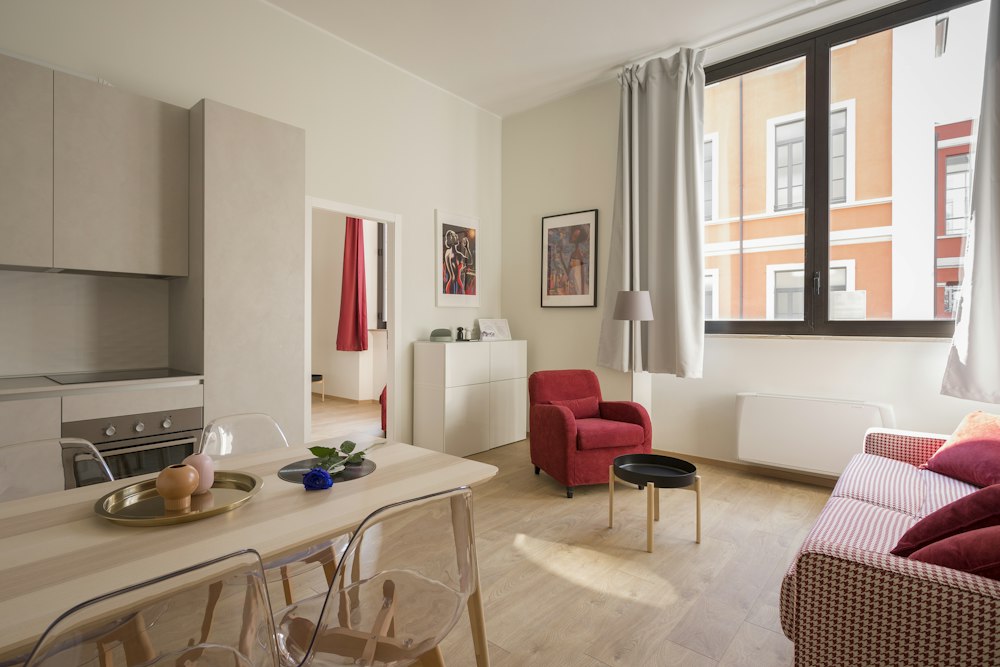
A studio’s problem isn’t storage, it’s that one room has to be three rooms. Sleeping, working and relaxing all happen in the same visual field, and without separation the space feels chaotic no matter how tidy it is.
You zone it without building anything:
- Rugs define zones. The most effective and least invasive tool. One rug under the bed, a different one under the sofa, and the brain reads two rooms. Sizing matters more than pattern — a rug too small for its zone makes the room feel smaller, not larger.
- Float furniture off the walls. Counterintuitive, but pushing everything flat against the walls creates one big empty middle that reads as a corridor. A sofa pulled 20–30cm forward, with its back facing the bed, becomes a soft divider and improves flow.
- Use furniture backs as walls. An open-backed bookcase divides sleeping from living while still passing light through. A solid one blocks light and makes both halves darker — pick deliberately.
- Curtain track on the ceiling. Cheap, renter-safe, and gives an actual visual wall around the bed you can open in the daytime.
- Lighting per zone. Possibly the most underrated trick here. A floor lamp by the sofa and a bedside lamp let you light one zone and leave the other dark, which does more for separation after dark than any physical divider.
- Keep one clear sightline from the door through to the window. It’s the line that tells you how big the room is.
Two practical constraints worth respecting: leave 60–75cm of walkway between furniture, and keep the bed out of the direct line of sight from the front door if you can. A studio where the first thing anyone sees is an unmade bed feels like a bedroom with a sofa in it, rather than a home.
Making a small space feel bigger
This is a different problem from the one above, and it’s worth being clear about that. Storage solves where does this go. None of it changes how the room feels. A perfectly organized flat can still feel like a box.
What actually changes the perception:
- Hang curtains high and wide — rod close to the ceiling, extending 15–20cm past the frame on each side. This single change makes windows read as much larger and the ceiling as higher. It’s free if you already own the curtains.
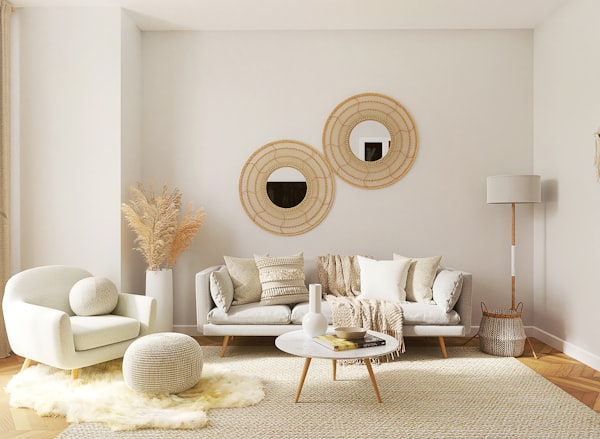
- Put a mirror opposite or beside a window, not on a random wall. It reflects daylight and doubles the sightline. A mirror facing a blank wall just reflects the wall.
- Choose furniture with visible legs. Seeing the floor continue underneath a sofa or bed makes a room read as larger. Solid-to-the-floor pieces stop the eye dead.
- Keep one consistent palette across walls, curtains and large furniture. Contrast breaks a room into pieces; continuity lets the eye travel and reads as space.
- Fewer, larger objects beat many small ones. One large artwork calms a wall that twelve small frames would make busy.
- Clear the floor. Visible floor area is what the eye measures. Wall-mounting anything currently standing on the floor — lamp, speaker, router, drying rack — buys perceived space immediately.
- Layer light instead of using one ceiling fixture. A single overhead light flattens a room and pushes the corners into shadow, which makes it feel smaller. Two or three lower light sources open the corners back up.
What to declutter first in a small space
Once you’ve claimed the unused space, decluttering does the rest — but the priorities are different when square footage is the constraint. Go after what takes the most room per unit of usefulness:
- Duplicates. Three frying pans, four sets of bedding, a second kettle. In a large home duplicates are invisible; here they cost you a cabinet.
- Seasonal and bulky gear. Winter coats, suitcases, sports equipment. If you can’t store it high or under the bed, it’s occupying prime space for eleven months of the year.
- Single-purpose kitchen gadgets. The worst offenders in a small kitchen — large, used rarely, and each one replaces something you’d use weekly.
- Furniture that does one job. Yes, furniture counts as clutter when space is the constraint.
- Anything stored for a hypothetical. The spare chairs for gatherings you have twice a year, kept at the cost of daily floor space.
For the full process — room order, realistic timings and what to do with everything you remove — work through our room-by-room decluttering guide. Do it before buying storage, not after. Buying containers first is how people end up with an organized version of too much stuff.
Common questions
How do I fit a home office in a studio apartment?
Go vertical and go folding. A wall-mounted drop-down desk takes 10cm when closed. Pair it with a chair that works elsewhere in the flat — a dining chair, not a bulky office chair — and a pegboard above for supplies, so nothing lives on the desk surface. The important part is psychological: being able to close or cover the workspace at the end of the day is what stops a studio feeling like an office you sleep in.
What furniture should I avoid in a small space?
Deep sofas, anything solid to the floor, bulky recliners, oversized bed frames with wide surrounds, and furniture that only does one thing. Also be wary of very low seating — it makes ceilings feel closer. If a piece can’t be moved by one person, think twice; small spaces need to be reconfigurable.
Do mirrors really make a room look bigger?
Placement decides it. Opposite or beside a window, a large mirror genuinely extends the sightline and spreads daylight. On a windowless wall it reflects clutter and does nothing. One large mirror beats several small ones.
Is it worth buying storage furniture for a rented flat?
For freestanding pieces you’ll take with you, yes — ottomans, carts, shelving units, bed risers all move house. For anything fixed to the wall, weigh it against how long you’re staying and what your agreement allows. Tension rods, adhesive rails and freestanding units get you most of the benefit with none of the deposit risk.
More guides on decluttering, decor and small-space living are in the Home & Living pillar.

Tayiba Shabir
Tayiba writes LifestyleRoot’s home and living guides — decluttering, minimalist decor, and making small spaces work harder.
Related guides
How to declutter your home, room by room
Do this before you buy any storage. Room order, timings and disposal.
Decluttering methods, compared
Which named system suits a small flat, and where KonMari breaks.
Minimalist home decor ideas
Where small-space living and minimalist decor genuinely overlap.