How to declutter your home, room by room
Start with the bathroom, not the garage. Here’s the room order that works, how long each one actually takes, and what to do with everything you pull out.

The short answer
- Start with the bathroom. It’s the fastest room, the decisions are objective, and finishing one room is what makes you start the next.
- Work easiest to hardest: bathroom → kitchen → living room → bedroom → paperwork.
- Budget 15–20 hours for a full home, spread across two to three weeks. Not a weekend.
- Sort into four boxes as you go: keep, relocate, donate, bin. Touch each item once.
- Get the donate bags out of the house within 48 hours, or they become new clutter.
Where to start decluttering (and why room order matters)
Start with the bathroom. Not the room that bothers you most — the room you can finish in under an hour.
Most people start with the worst room in the house: the garage, the spare room that became storage, the cupboard nobody opens. It’s the logical choice and it’s why most decluttering attempts die on day one. Those rooms hold the hardest decisions, the most sentimental items, and the least visible payoff. You spend four hours, you’re exhausted, the room looks marginally different, and you don’t come back the next weekend.
Room order should follow decision difficulty, not mess severity. Here’s the order that works, and the reasoning behind it:
| Order | Room | Why here |
|---|---|---|
| 1 | Bathroom | Expiry dates make most decisions for you. Almost no sentiment involved. |
| 2 | Kitchen | Mostly objective — it works or it doesn’t, you use it or you don’t. |
| 3 | Living room | Largely other rooms’ clutter. Easy wins, high visibility. |
| 4 | Bedroom & closet | Clothes carry more emotional weight than people expect. |
| 5 | Paperwork & sentimental | Slowest decisions. Do these last, when you’ve built the habit. |
If your constraint is square footage rather than volume — a studio, a one-bed, a shared room — read how to organize a small apartment alongside this. The room order still applies, but what you do with the space afterwards is different.
There’s a skill being built here, not just rooms being cleared. Deciding what to keep is a muscle, and the bathroom is where you train it cheaply. By the time you reach a box of photographs, you’ve made four hundred small decisions and you’re much faster at it.
If you’d rather follow a named system than a room order, our comparison of decluttering methods covers KonMari, the four-box method and minimalist approaches side by side. This guide is the room-by-room version, which is what most people actually want when they ask where to start.
The four boxes — set these up before you touch anything
Keep (belongs here), Relocate (belongs elsewhere in the house), Donate, Bin or recycle. A cardboard box and three carrier bags is fine. The rule that makes it work: pick each item up once, decide, put it in a box. No “maybe” pile — a maybe pile is just the original mess with extra steps.
How long decluttering actually takes
Longer than the internet suggests, and less than you fear. Here are realistic figures for an average two-bedroom home with a normal amount of accumulated stuff:
| Room | Realistic time | Sessions |
|---|---|---|
| Bathroom | 45–60 minutes | 1 |
| Kitchen | 3–4 hours | 3–4 |
| Living room | 2–3 hours | 2 |
| Bedroom & closet | 4–5 hours | 3–4 |
| Paperwork & sentimental | 4–8 hours | 4+ |
| Full home | 15–20 hours | Spread over 2–3 weeks |
The sessions column matters more than the hours. Fifteen hours sounds like a long weekend, and people try to do it as one — which is exactly the mistake. Decision fatigue is real and it arrives somewhere around the ninety-minute mark. Past that point you start keeping things simply because deciding is too much effort, which is how people finish a marathon session having removed almost nothing.
Work in 20 to 45 minute blocks, one drawer or one surface at a time. Stop while you can still make a clean decision. Four sessions of forty minutes will clear more than one session of four hours, and you’ll still be willing to do it again on Thursday.
Room-by-room decluttering checklist
Each room below is a checklist, not an essay. Work down it in order.
Bathroom
Your first room and your fastest. Most of it decides itself.
- Empty every cabinet and drawer onto a towel on the floor. All of it, at once.
- Bin anything expired, dried out, separated, or opened more than a year ago.
- Take unused or expired medication to a pharmacy. Not the bin, not the toilet.
- Keep one backup of each essential — one spare toothpaste, not five.
- Put daily items at eye level; everything else goes higher or lower.
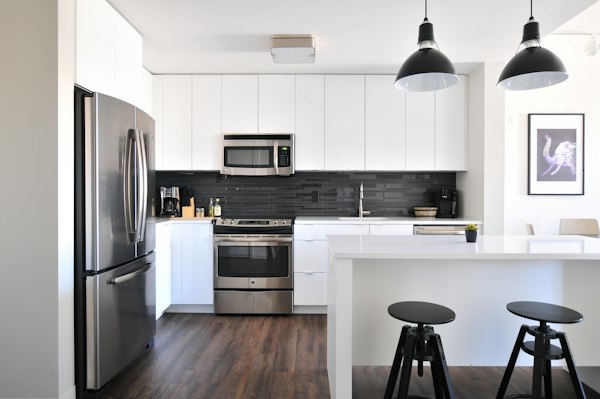
Kitchen
The kitchen gives the best return of any room because you use it several times a day. Split it across three or four sessions rather than attempting it in one.
- Countertops first. Anything not used daily goes into a cupboard — appliances included. Clear counters make a kitchen read as clean even when it isn’t.
- Fridge and pantry. Check dates. Be honest about the ambitious ingredient bought for one recipe two years ago.
- Utensil drawer. Most households own three spatulas and use one.
- Food containers. Match every lid to a base. Anything unmatched goes, in both directions. This drawer is usually the single biggest win in the room.
- Mugs and glassware. Count what you own against how many people live here and how often you host.
- The gadget cupboard. If it hasn’t been used in a year, it won’t be used next year either.
Once the volume is down, how you store what’s left matters — our guide to home organization systems covers drawer dividers and shelf risers, and which are worth buying.

Bedroom & closet
Slower than it looks. Clothes carry more weight than kitchen equipment — a jacket represents money spent, a size you used to be, or a version of yourself you’d like to get back to. Expect this room to take three or four sessions.
- Everything out of the closet, onto the bed. The bed is the forcing function: you have to finish before you can sleep.
- Sort by category, not location — all trousers together, all jumpers together. You cannot see that you own nine black t-shirts until they’re in one pile.
- Try on anything you’re unsure about. Once. Not tomorrow.
- Bedding and towels: two sets per bed, three towels per person is plenty for most homes.
- Bedside drawer: if you’d forgotten it was in there, it goes.
- Under the bed: the place things go to be forgotten. Empty it fully.
For clothes you genuinely can’t judge, use the reverse-hanger trick: turn every hanger backwards today, and turn it the right way round when you wear something. In three months, whatever is still backwards hasn’t been worn — and now you have evidence instead of a guess.
Living room
Living rooms accumulate other rooms’ belongings more than their own. Most of what’s on the floor lives somewhere else.
- Do a relocate pass first — collect everything that belongs in another room into one box. Don’t deliver it yet.
- Clear the coffee table and the media unit completely, then put back only what earns its place.
- Cables. Gather every loose one. If you can’t name the device it belongs to, it goes.
- Books and magazines: keep what you’ll genuinely reread or haven’t read yet. Not what looks good on a shelf.
- The catch-all basket by the door — empty it entirely and don’t refill it.
Home office & paperwork
Last, and slowest. Paper decisions are individually tiny and collectively exhausting, so keep sessions short.
- Three piles: shred, file, action. Nothing else.
- Keep tax records for as long as your country requires — commonly six years. Check your own rules before shredding.
- Bin manuals for appliances you no longer own, and for anything whose manual is online.
- Switch statements and bills to paperless as you go, so the pile stops regenerating.
- Stationery: you don’t need forty pens, and roughly a third of them don’t write.
What to do with everything you remove
This is where decluttering usually stalls. The bags get sorted, then sit in the hallway for six weeks and eventually get unpacked again. The rule that prevents it: anything leaving the house has 48 hours.
Decide the route by asking two questions in order — is it usable, and is it worth the effort of selling?
| Route | Use it when | Don’t bother when |
|---|---|---|
| Sell | Worth roughly what an hour of your time is worth — furniture, electronics, branded clothing in good condition | It’d fetch pocket change. Listing, messaging and posting takes longer than the item is worth |
| Donate | Clean, working, complete. Most clothes, books, kitchenware, toys | Stained, broken, or missing parts — charities pay to dispose of unusable donations |
| Give directly | You know someone who needs it. Fastest route of all | You’re offering it to be polite and they’ll feel obliged to accept |
| Recycle | Electronics, batteries, textiles, paint — most have a specific local route | Never for these: they don’t belong in a household bin |
| Bin | Genuinely broken, unusable or unsanitary | It’s still perfectly good and you’re just tired of deciding |
A practical shortcut: give selling a deadline. List it, and if it hasn’t sold in two weeks, it gets donated. Without that rule, “I’ll sell this” becomes an indefinite holding pattern and the box lives in the hallway until spring.
Book the collection before you start
If you’re expecting a lot of volume, schedule a charity collection or a tip run before your first session. A fixed date does more for follow-through than any amount of motivation, and it stops the bags becoming furniture.
How to keep it from piling back up
Decluttering is a project. Staying decluttered is a habit, and it’s a much smaller one — around ten minutes a day of putting things back where they live, plus one-in-one-out on the categories that grow fastest.
That’s the whole principle, and it’s genuinely most of the battle. We’ve broken down the routines, the container rule and what to do when it slips in a separate guide: how to stay clutter-free without a system.
Common questions
How do I declutter sentimental items?
Separately, and last. Never mix sentimental items into a normal session — they slow you to a stop and derail the whole room. Give them a dedicated hour and set a physical limit before you start: one box. What fits, stays. For things you want the memory of but not the object, photograph it before it goes.
Should I declutter before or after cleaning?
Before, always. Cleaning around clutter means moving the same objects twice and doing a worse job. Clear the surface, then clean it — you’ll do both faster.
What if I share the home and they won’t declutter?
Only ever sort your own belongings and shared-category items you’re both fine with. Decluttering someone else’s things without asking damages the relationship far more than the clutter was costing you. In practice, a visibly clearer shared space often does the persuading on its own.
How often should I do this?
A full pass like this one is a one-off, or once every few years after a big life change — a move, a new baby, a household leaving. With a ten-minute daily reset, you shouldn’t need to repeat it annually. If you do, the problem isn’t the decluttering, it’s what’s coming through the front door.
For more on the sections above, browse the full Home & Living pillar.

Tayiba Shabir
Tayiba writes LifestyleRoot’s home and living guides — decluttering, minimalist decor, and making small spaces work harder.
Related guides
Decluttering methods, compared
KonMari, four-box and minimalism — which one suits how you actually decide.

How to organize a small apartment
What changes when you can’t move things to another room.

How to stay clutter-free
The ten-minute habit that stops you needing this guide again.