How to declutter your kitchen (step by step)
Counters first, cabinets second, pantry last. That order matters more than any single decision you’ll make, and it’s the opposite of how most guides tell you to do it.
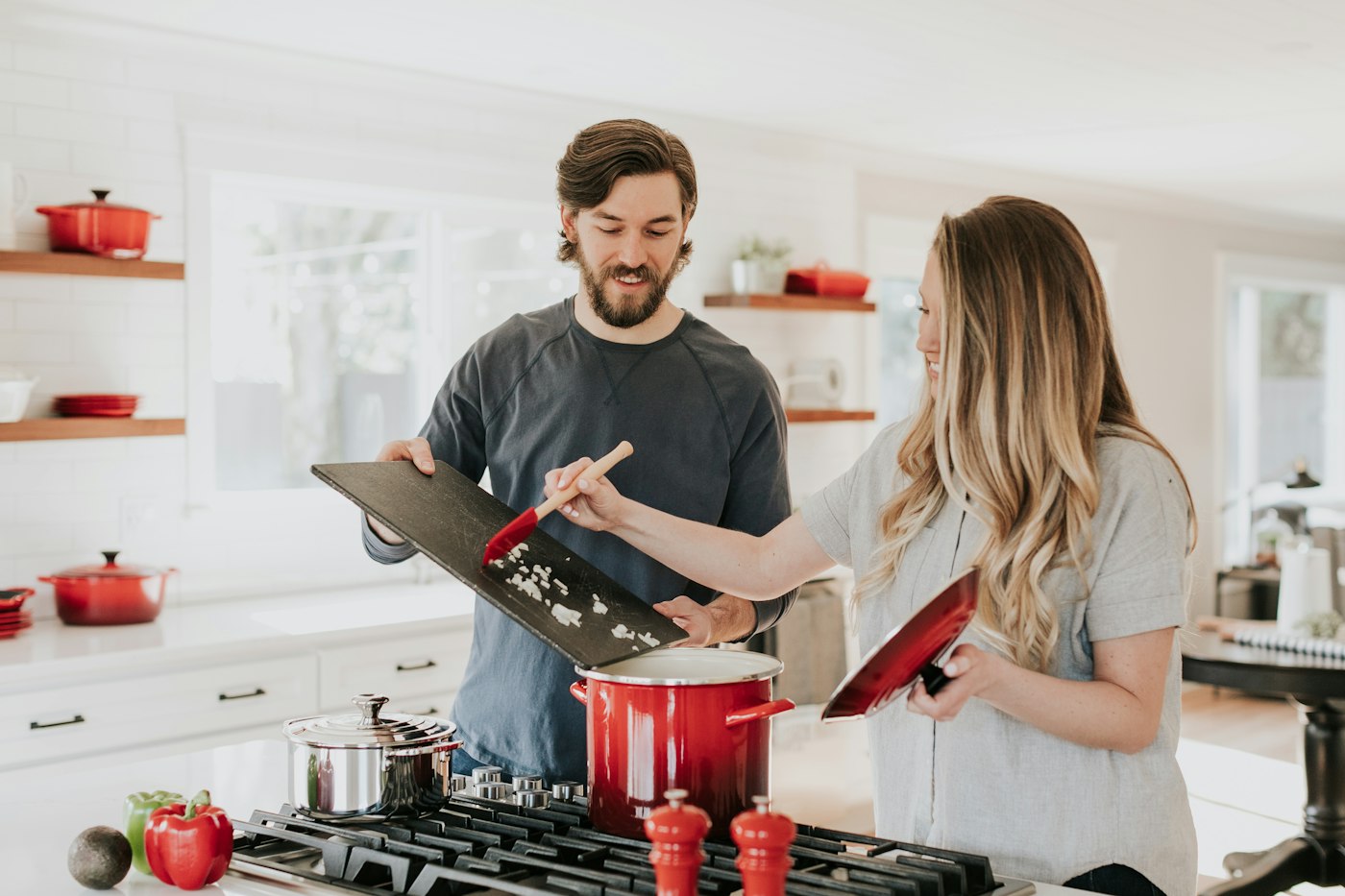
This is the deep-dive version of the kitchen section in our room-by-room guide. Budget three or four hours total, split across a few sessions — the kitchen gives the best return of any room because you’re in it several times a day, but doing it in one sitting is how people burn out on the container drawer.
The order is counters, then cabinets and drawers, then the pantry. Work in that sequence even if the pantry is the part bothering you.
Why kitchens accumulate faster than other rooms
Four things are working against you here, and none of them are about tidiness.
It’s the highest-traffic room in the house. Everything gets used, set down, half put away, and used again within hours. No other room turns over that fast.
Duplicates arrive invisibly. Nobody decides to own three spatulas. You buy one, inherit one, get one in a set, and because they live in different drawers you never see them together.
Gadgets are the default gift. Specialist kitchen tools are what people buy when they don’t know what to buy, and the ones you didn’t want are the hardest to let go of, because someone chose them for you.
Cookware outlives the life it was bought for. The pans from a bigger household, the baking tins from a phase, the equipment for the way you cooked ten years ago. It all still works, which is exactly why it’s still there.
And if more than one person uses the kitchen, add a fifth: nobody agrees where things live. Two people putting the same item in two different places means it has no home, and anything without a home ends up on a surface. That’s worth sorting out loud before you start, because it’s the difference between this lasting a month and lasting a year.
Start with counters
Twenty to thirty minutes, and it changes how the whole room reads. Counters are what you see when you walk in, so clearing them makes the kitchen feel decluttered before you’ve opened a single cupboard — which is the motivation you need for the slower parts.
Take everything off. All of it, onto the table. Wipe the whole surface down. Then put back only what passes one test: do you use it every day?
| Earns counter space | Store in a cupboard | Reconsider entirely |
|---|---|---|
| Kettle | Blender | The bread maker |
| Coffee setup, if daily | Food processor | Appliances used once |
| Knife block or strip | Stand mixer, unless you bake weekly | Anything with a broken part |
| Utensil pot, edited down | Toaster, if used a few times a week | Decorative items that collect grease |
Two things that usually need saying. The paper — post, receipts, school letters — doesn’t live in the kitchen, it lives in one tray somewhere else. And the appliance you keep out because getting it out is annoying is telling you something real: if you use it weekly, store it at the front of a low cupboard rather than at the back of a high one.
While you’re here, do the drawer. Every kitchen has one holding batteries, takeaway menus, dead pens, mystery keys and a screwdriver. It’s a fifteen-minute job and most of what’s in it is rubbish, so it’s an easy second win before you start on cupboards where the decisions get harder.
The reason counters come first isn’t just motivation, though that’s real. It’s that you need somewhere to put things. Emptying a cupboard onto a counter that’s already full doesn’t work, and the next two stages both depend on having a large clear surface to work on.
Cabinets and drawers
Slower, and best done one cupboard per session rather than all at once. Empty the cupboard completely each time — you can’t judge what you own while half of it is still at the back.
Cookware and bakeware
Use the one-of-each test: for every type and size, keep the one you actually reach for. One large frying pan, one small. One saucepan per size you genuinely use at the same time — count your hobs, that’s your realistic ceiling for simultaneous cooking.
If you’re unsure which of two similar pans you prefer, you already know. It’s the one that isn’t at the back.
- Match every lid to a pot or container. Unmatched items go, in both directions. This drawer is usually the single biggest win in the room.
- Baking tins — keep the shapes you’ve used in the last two years. Novelty tins from one birthday are the classic hold-out.
- Anything with a damaged non-stick coating is past its useful life and worth replacing rather than storing.
- Plastic containers: keep a set that stacks and has matching lids. Mismatched ones multiply on their own.
Gadgets and single-use tools
Be straightforward with yourself here. Two questions settle almost every item:
Have you used it in the last twelve months? And can something you already own do the same job? A knife handles what most single-purpose choppers, corers and slicers do, slightly less neatly and without taking a drawer.
That said, a single-use tool you genuinely use is worth keeping even if it’s seasonal. A garlic press you reach for weekly earns its place; the avocado tool from a gift set does not. The test is use, not how specialised it looks.
The gifted-gadget problem deserves naming: keeping something unused because of who gave it doesn’t honour them, it just stores obligation in a drawer. They gave it to you. What happens next is yours to decide.
Dishes and glassware
Right-size to your household rather than to hypothetical entertaining.
A useful figure for everyday sets: the number of people who sit at your table, plus two. Anything beyond that is occasional-use stock, and occasional-use stock can live high up or elsewhere entirely.
Mugs are where every kitchen overflows — count yours against how many people live there. And a quiet test for plates and bowls: if you own more than about two dishwasher loads’ worth, part of what you’re storing is a way to avoid washing up.
Chipped or cracked items go. Glassware you’ve kept for fifteen years and never used goes.
Once the volume is down, what’s left needs storing properly — dividers, risers, zoning by task. That’s a separate subject and it’s covered in our home organization systems guide rather than here.
The pantry
A different job from the cabinets, with a different failure mode. Cabinets accumulate; pantries expire. Treat it as its own session.
Everything out onto the counter you just cleared, then work through in this order:
- Check dates, and know which kind you’re looking at. Use-by is a safety date and shouldn’t be pushed. Best-before is about quality — dry goods past it are usually fine, just less good. That distinction saves a lot of unnecessary waste.
- Consolidate duplicates. Three half-open bags of the same rice become one container. You’ll find you own four of something you were about to buy again.
- Group by category as you put things back — baking together, tins together, snacks together. Categories are what stop the pantry needing this again in two months.
- Newest to the back. First in, first out prevents most of the expiry problem recurring.
- Frequency decides height. Daily items at eye level, occasional above or below. Eye level is the most valuable space in the kitchen and usually holds the least-used things.
If you find unopened, in-date food you won’t use, a food bank will take it. That’s a better outcome than it sitting until it expires, and it’s worth checking what your local one accepts.
What to actually get rid of
The categories that are almost always safe, if you want to move fast:
- Duplicates beyond what you use at once
- Single-use gadgets unused in a year
- Containers with no lid, lids with no container
- Expired food, and opened items you can’t date
- Chipped, cracked or broken items
- Pans with damaged coatings
- Gifted items still unused after a couple of years
- Cookware for a way of cooking you’ve stopped doing
- Takeaway containers, sauce sachets and spare cutlery from deliveries
Anything usable can be donated — charity shops take kitchenware readily, and it’s one of the categories they most reliably sell.
Keeping the kitchen from re-cluttering
Two habits hold it, and neither takes long.
Clear the counters as part of the evening tidy rather than as a task of its own. A kitchen with clear counters reads as clean even when the floor needs doing, and resetting one day’s worth takes a couple of minutes.
Then one-in-one-out on the categories that grow: mugs, containers, gadgets. New one in, old one out.
The wider habits are in how to keep your house decluttered, and the storage side — what to buy, what not to — is in home organization systems. Do the storage thinking after this, not before. Buying containers first is how people end up with a neatly organised version of too much.
Two questions
How often should you declutter your kitchen?
A full pass like this one every year or two is plenty if you’re clearing counters daily. The pantry benefits from a quick check every few months, ideally before a big shop, since that’s when you’d otherwise rebuy something you already own.
Which kitchen gadgets are actually worth keeping?
The ones you use, which is a shorter list than the ones you own and different for every household. Rather than a universal list: keep what you’ve used in the last year, be sceptical of anything that does one job a knife could do, and give a genuine second chance to things you’d use more if they weren’t buried at the back.
What if I have a very small kitchen?
The method is the same, but the counter rule gets stricter — in a small kitchen, counter space is workspace, so anything living on it is costing you the ability to cook. Aim for the kettle and nothing else, and look upward for the things you displaced: the wall above the counter and the space above the cupboards are usually the largest unused areas in a small kitchen.
More guides on decluttering, organising and small spaces are in the Home & Living pillar.

Tayiba Shabir
Tayiba writes LifestyleRoot’s home and living guides — decluttering, minimalist decor, and making small spaces work harder.
Related guides
The best home organization systems
What to do with everything that’s left — zoning, dividers, and what’s worth buying.
How to declutter your wardrobe
The other single-category deep dive, with a concrete rule for the maybe pile.

How to keep your house decluttered
The evening reset that keeps counters clear without it becoming a job.